English
 العربية
 Español
 Deutsch
 Русский
 Italiana

Macedonian Mix vs Mediterranean Pickle Blends Explained
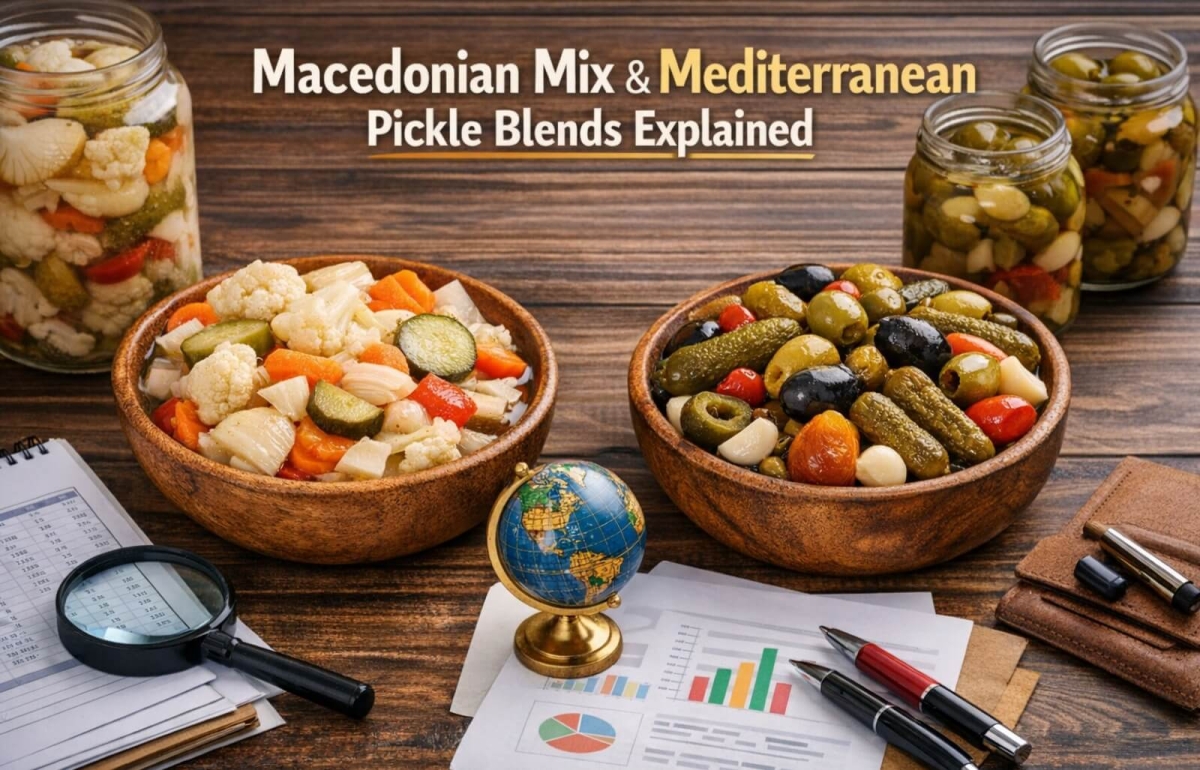
Macedonian Mix & Mediterranean Pickle Blends Explained
Mixed pickled vegetables have become an essential category within the global food industry. From retail shelves to foodservice menus, these products offer variety, convenience, and consistent flavor profiles.
Among the most recognized varieties are Macedonian mix and broader Mediterranean pickle blends, both widely used across European and international markets.
Understanding the differences between these blends helps importers, distributors, and food manufacturers select the right products for their target markets.
What Is Macedonian Mix?
Macedonian mix is a traditional combination of pickled vegetables known for its colorful appearance and balanced taste.
It typically includes:
- carrots
- cauliflower
- cucumbers
- peppers
- sometimes olives or chili
The vegetables are cut into small pieces and preserved in brine, creating a mix that is both visually appealing and easy to use.
This product is commonly used in:
- retail jars
- deli counters
- salads and side dishes
What Are Mediterranean Pickle Blends?
Mediterranean pickle blends refer to a broader category of mixed pickled vegetables inspired by regional recipes across the Mediterranean.
These blends may vary depending on the supplier and market requirements but often include:
- olives
- peppers
- gherkins
- jalapeños
- carrots
- garlic
Compared to Macedonian mix, Mediterranean blends offer more flexibility in composition and flavor profiles.
Key Differences Between Macedonian Mix and Mediterranean Blends
While both products fall under mixed pickled vegetables, there are some important differences:
Macedonian Mix:
- more standardized composition
- smaller cut vegetables
- traditional flavor profile
- widely recognized in European retail
Mediterranean Blends:
- more flexible ingredients
- customizable recipes
- adapted to different markets
- broader product positioning
This distinction is important for buyers looking to match products with specific market expectations.
Applications in the Food Industry
Both Macedonian mix and Mediterranean blends are widely used across multiple sectors:
- retail packaged products
- horeca (restaurants and catering)
- food manufacturing
- ready meals and salads
Their versatility makes them a practical solution for distributors and foodservice operators.
What Importers and Buyers Look For
When sourcing mixed pickled products, importers typically focus on:
- consistent vegetable quality
- uniform cutting and presentation
- stable brine formulation
- flexibility in product specifications
- reliable export supply
Suppliers who can offer both standardized mixes and customizable blends are better positioned to support different market needs.
Which Blend Fits Your Market?
Choosing between Macedonian mix and Mediterranean pickle blends depends on your target market and product strategy.
Macedonian Mix is a better fit when:
- targeting traditional European retail markets
- offering standardized, ready-to-sell products
- focusing on high-volume retail distribution
- serving customers familiar with classic pickled mixes
Mediterranean Pickle Blends are more suitable when:
- targeting diverse or international markets
- developing private label products
- supplying foodservice or food manufacturing sectors
- offering product differentiation and flexibility
A Practical Approach for Importers
Many importers choose to include both options in their portfolio:
- Macedonian mix for stable retail demand
- Mediterranean blends for flexible and customized applications
This approach allows distributors to serve multiple segments while adapting to evolving market trends.
Packaging and Supply Options
Mixed pickled products are available in different packaging formats depending on the market:
- retail jars
- foodservice tins
- bulk containers
- private label packaging
Flexible packaging supports both retail distribution and industrial use.
Macedonian mix and Mediterranean pickle blends both play an important role in the global pickled vegetable market.
While Macedonian mix offers a traditional and standardized solution, Mediterranean blends provide flexibility and customization for modern food markets.
For importers and distributors, understanding these differences is essential for building a strong and adaptable product portfolio.
FAQ
What is Macedonian mix made of?
It typically includes carrots, cauliflower, cucumbers, and peppers in a balanced pickled blend.
What are Mediterranean pickle blends?
They are mixed pickled vegetables with flexible ingredients such as olives, peppers, gherkins, and jalapeños.
What is the main difference between the two?
Macedonian mix is more standardized, while Mediterranean blends are more customizable.
Where are these products used?
They are widely used in retail, horeca, and food manufacturing sectors.