English
 العربية
 Español
 Deutsch
 Русский
 Italiana
Olive Harvest 2026: Egypt vs Spain, Greece & Türkiye
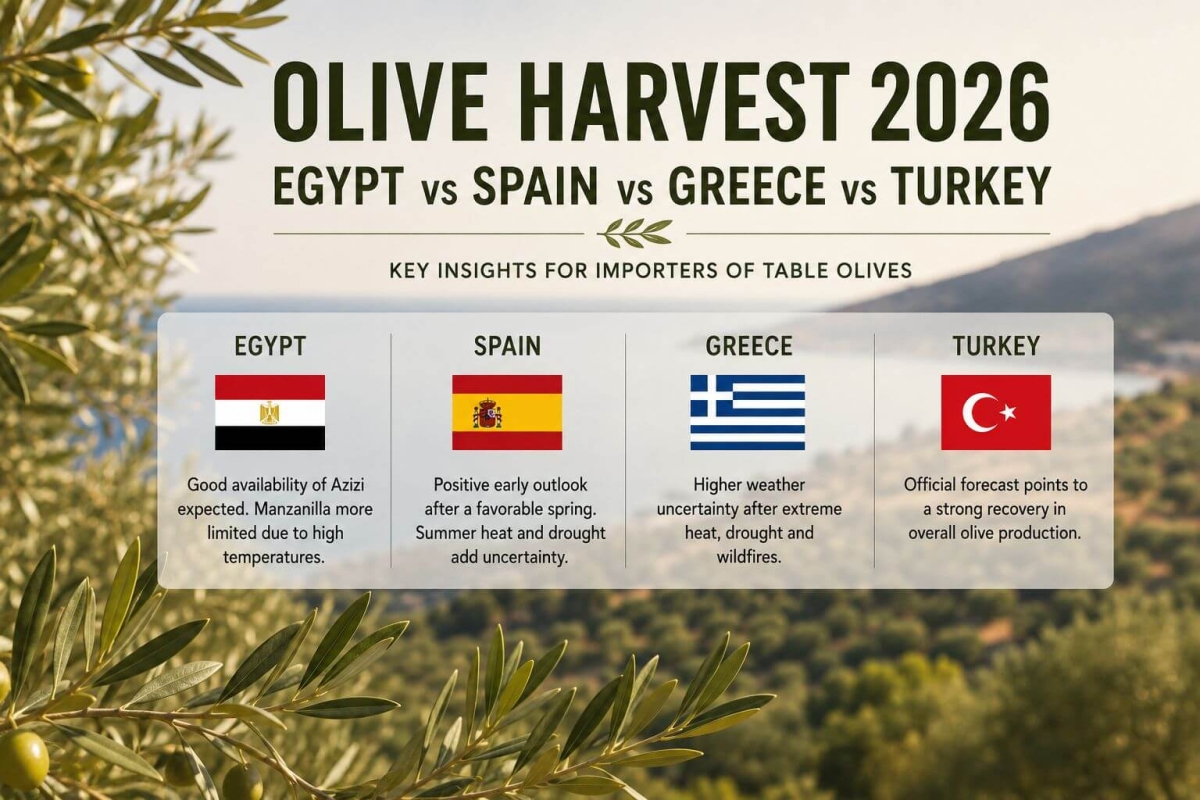
Olive Harvest 2026: Egypt vs Spain, Greece & Türkiye — What Importers Should Watch Before the New Season
The 2026 olive harvest is approaching across the Mediterranean, and for table olive importers, the weeks before the new crop are an important procurement window.
Spain entered the summer with positive early crop expectations following favorable spring conditions. Türkiye is forecasting a significant recovery in overall olive production. Greece, meanwhile, has faced greater weather uncertainty following periods of extreme summer heat, drought and wildfire activity.
In Egypt, early observations within our own sourcing program indicate a particularly interesting season at variety level: Azizi olives are expected to be available in strong commercial volumes, while Manzanilla availability is expected to be tighter following periods of elevated temperatures during fruit development.
For importers planning their 2026/27 sourcing programs, this illustrates an important point:
A country's total olive crop does not tell the whole procurement story.
Variety availability, fruit size, calibration, harvest timing, processing requirements and committed volumes can matter just as much as national production forecasts.
2026 Olive Harvest Outlook at a Glance
| Origin | 2026 Pre-Harvest Indicator | What Importers Should Watch |
|---|---|---|
| Egypt | Strong Azizi availability expected within our sourcing program; tighter Manzanilla availability | Variety availability, calibration and early volume planning |
| Spain | Positive early outlook following favorable spring conditions, followed by summer heat and drought concerns | Final fruit development, sizing and regional availability |
| Greece | Greater weather uncertainty following severe summer heat, drought and wildfire activity | Regional crop conditions and variety availability |
| Türkiye | Official forecast indicates a strong recovery in overall olive production | Table-olive availability by variety and commercial grade |
These indicators remain pre-harvest signals rather than final production results. Conditions can continue to develop as producing regions move toward harvest.
Egypt Olive Harvest 2026: Azizi Takes the Spotlight
Egypt's climate and established olive-growing areas support the production of multiple table olive varieties for processing and export.
For the 2026 Egyptian olive season, our current sourcing observations indicate stronger availability for Azizi olives, while commercial availability of Manzanilla is expected to be more limited.
This distinction matters for importers.
Stronger Azizi Availability in 2026
Azizi is one of the Egyptian varieties worth watching this season.
Based on our current sourcing program, Azizi olives are expected to be available in good commercial volumes for the 2026 crop.
For international buyers, availability at variety level can influence decisions concerning:
- required calibrations;
- whole or processed formats;
- bulk purchasing programs;
- packaging selection;
- private-label production;
- and annual contracted volumes.
Importers with flexibility regarding variety may therefore find Azizi particularly relevant when planning Egyptian table olive sourcing for the coming season.
Manzanilla Availability Expected to Be Tighter
Manzanilla remains an important commercial table olive variety, but our current observations indicate lower expected availability within our sourcing program for 2026.
Periods of elevated temperature during fruit development have affected expectations for this variety.
This does not mean that Manzanilla will be unavailable. It means buyers requiring specific Manzanilla volumes should consider discussing their requirements earlier, particularly where contracts involve specific calibrations, processing formats or packaging programs.
It also demonstrates why professional olive sourcing should be evaluated variety by variety rather than simply country by country.
Spain Olive Harvest 2026: Positive Spring Outlook Meets Summer Weather Risk
Spain remains one of the world's most important olive-producing countries and a major reference point for Mediterranean olive sourcing.
In July 2026, Spain's Ministry of Agriculture reported that initial expectations for the 2026/27 olive crop were above the current season, supported by favorable climatic conditions during the spring.
For context, Spain's 2025/26 table olive production was approximately 503,000 tonnes, according to Spanish Ministry of Agriculture market data.
However, the outlook became more complex as the summer progressed.
Extreme heat, drought conditions and wildfires affected parts of southern Europe during the summer, creating additional uncertainty for agricultural production and olive-growing regions.
For table olive buyers, this means Spain entered the season with encouraging early conditions, but final fruit development and commercial availability still need to be monitored as harvest approaches.
Importers should pay particular attention to:
- fruit size and calibration;
- regional differences;
- water availability;
- variety-specific production;
- and the effect of late-summer conditions on final crop quality.
Spain's table olive marketing campaign begins on 1 September, making the late-summer period particularly relevant for procurement planning.
Türkiye Olive Harvest 2026: A Strong Production Rebound Is Forecast
Türkiye presents one of the strongest numerical signals among the origins examined for 2026.
According to the first official 2026 crop estimate published by the Turkish Statistical Institute (TurkStat), total olive production is forecast to increase by 55.7% compared with 2025.
That is a significant year-on-year recovery indicator.
However, international table olive buyers should interpret the figure carefully.
The forecast relates to olive production overall rather than providing a separate forecast exclusively for table olives.
Consequently, a strong national crop forecast does not automatically establish the availability of every table olive variety, size or commercial specification.
As the Turkish harvest approaches, importers should continue monitoring:
- table-olive-specific availability;
- variety distribution;
- commercial calibrations;
- processing capacity;
- and export availability.
A further official Turkish crop estimate is expected later in the season, providing an opportunity to reassess the outlook as more crop information becomes available.
Greece Olive Harvest 2026: Weather Uncertainty Remains a Key Factor
Greece is another major Mediterranean olive origin, but its 2026 pre-harvest picture currently requires greater caution.
Severe heat, drought and wildfire activity affected parts of Greece and southeastern Europe during the summer of 2026.
These conditions have increased uncertainty around agricultural production in affected regions.
At the time of writing, however, a sufficiently reliable nationwide 2026 Greek table olive production forecast was not available to justify stating a specific increase or decrease in national table olive output.
That distinction is important.
Weather pressure is an early risk indicator, not automatically evidence of a poor national harvest.
For importers sourcing Greek table olives, the more appropriate approach is therefore to monitor:
- conditions by production region;
- variety-specific availability;
- fruit development and sizing;
- harvest timing;
- and confirmed supplier volumes as the season progresses.
Egypt vs Spain vs Greece vs Türkiye: Which Olive Origin Is Best for 2026?
There is no universally "best" origin.
For professional importers, the better question is:
Which origin can meet the required variety, calibration, specification, processing format, packaging and volume for a particular sourcing program?
A large national harvest can improve overall supply conditions but still leave specific varieties or sizes relatively tight.
Similarly, a country experiencing weather pressure can still produce commercially attractive volumes in unaffected regions or varieties.
This is why procurement decisions should move beyond national crop headlines.
6 Factors Table Olive Importers Should Compare
1. Variety availability
Manzanilla, Azizi and other commercial varieties do not necessarily respond to growing conditions in the same way.
2. Calibration
Fruit size directly affects commercial applications and buyer specifications. Buyers requiring defined counts or grades should confirm expected availability before finalizing contracts.
3. Processing format
Whole, pitted, sliced and stuffed olives serve different retail, foodservice and industrial applications.
4. Packaging
Bulk drums and pails serve different procurement requirements from A10 tins, glass jars, PET packaging or retail private-label formats.
5. Processing and quality control
Crop availability alone is not enough. Buyers also need reliable processing, sorting, fermentation, packing and quality-control capabilities.
6. Supply planning
For annual programs, discussing expected volumes before or during the early harvest period can provide greater visibility over variety, size and packaging requirements.
Why the Pre-Harvest Period Matters for Olive Importers
Waiting until finished products are already available may reduce sourcing flexibility.
Importers operating annual supply programs often need to coordinate:
raw-material availability → calibration → processing → packaging → production scheduling → shipment planning.
The earlier these requirements are defined, the easier it becomes for producers and exporters to align available crop characteristics with buyer specifications.
This is particularly relevant in seasons such as 2026, where early indicators differ considerably by origin and even by variety.
In Egypt, for example, our current observations point toward stronger Azizi availability alongside tighter Manzanilla availability.
For a buyer who can work with several suitable varieties, that information may influence purchasing strategy.
For a buyer whose specification requires Manzanilla specifically, it makes early volume planning more important.
What Should Importers Watch as the 2026 Harvest Begins?
The outlook described above should not be treated as a final harvest result.
Between August and the completion of harvesting, weather, fruit development and field conditions can continue to affect commercial availability.
Importers should therefore watch three types of information separately:
Official production forecasts — useful for understanding the overall direction of supply.
Regional and weather indicators — useful for identifying potential risks before final harvest figures become available.
Supplier-level crop information — important for understanding actual varieties, calibrations and volumes available for commercial contracts.
Together, these provide a much more useful procurement picture than national production numbers alone.
Planning Your 2026/27 Egyptian Olive Sourcing Program
For importers, distributors, foodservice suppliers and private-label brands planning the 2026/27 table olive season, the period before and during harvest is an opportunity to align purchasing requirements with expected crop availability.
2Brother works with Egyptian olive production and processing programs for international B2B markets, covering different olive varieties, commercial forms and packaging requirements.
For the 2026 season, Azizi is currently expected to offer particularly good commercial availability within our sourcing program, while buyers requiring Manzanilla should consider discussing expected volumes earlier due to tighter availability.
Buyers can review our Egyptian green olive range for available whole, pitted, sliced and stuffed formats and discuss required calibrations, packaging formats and annual volumes with our export team.
Planning your 2026/27 olive program? Contact our export team to discuss expected volumes, varieties, calibrations, packaging and private-label requirements before the new crop enters full production.