English
 العربية
 Español
 Deutsch
 Русский
 Italiana
Global Pickled Vegetable Market Outlook 2026: Trade Trends, Growth Opportunities & B2B Insights
Global Pickled Vegetable Market Outlook 2026: Where International Buyers Should Focus Next
The global market for pickled vegetables continues to evolve as food importers seek reliable suppliers, competitive pricing, and diversified sourcing strategies. Rising consumer demand for convenient, healthy, and Mediterranean-inspired foods has strengthened international trade, while supply chain resilience has become a priority for distributors, retailers, and food manufacturers worldwide.
According to the latest Trade Map and ITC Export Potential Map data (HS Code 200190), Egypt continues to strengthen its position as a competitive supplier of pickled vegetables, with growing opportunities across Europe, North America, and selected Middle Eastern markets.
Rather than relying on a limited number of destinations, international buyers are expanding their sourcing networks to improve supply security, reduce procurement risks, and respond more effectively to changing consumer demand.
Global Market at a Glance
| Indicator | 2025 Status |
|---|---|
| Product | Pickled Vegetables (HS 200190) |
| Key Growth Regions | Europe, North America, Middle East |
| Egypt's Strongest Export Markets | Germany, United States, France, United Kingdom, Italy |
| Emerging Opportunities | Canada, Netherlands, Spain, Romania, Czech Republic |
Egypt's Largest Export Destinations
Trade Map data shows that Egypt's exports remain highly concentrated in a number of established international markets.
| Market | Export Value Potential |
|---|---|
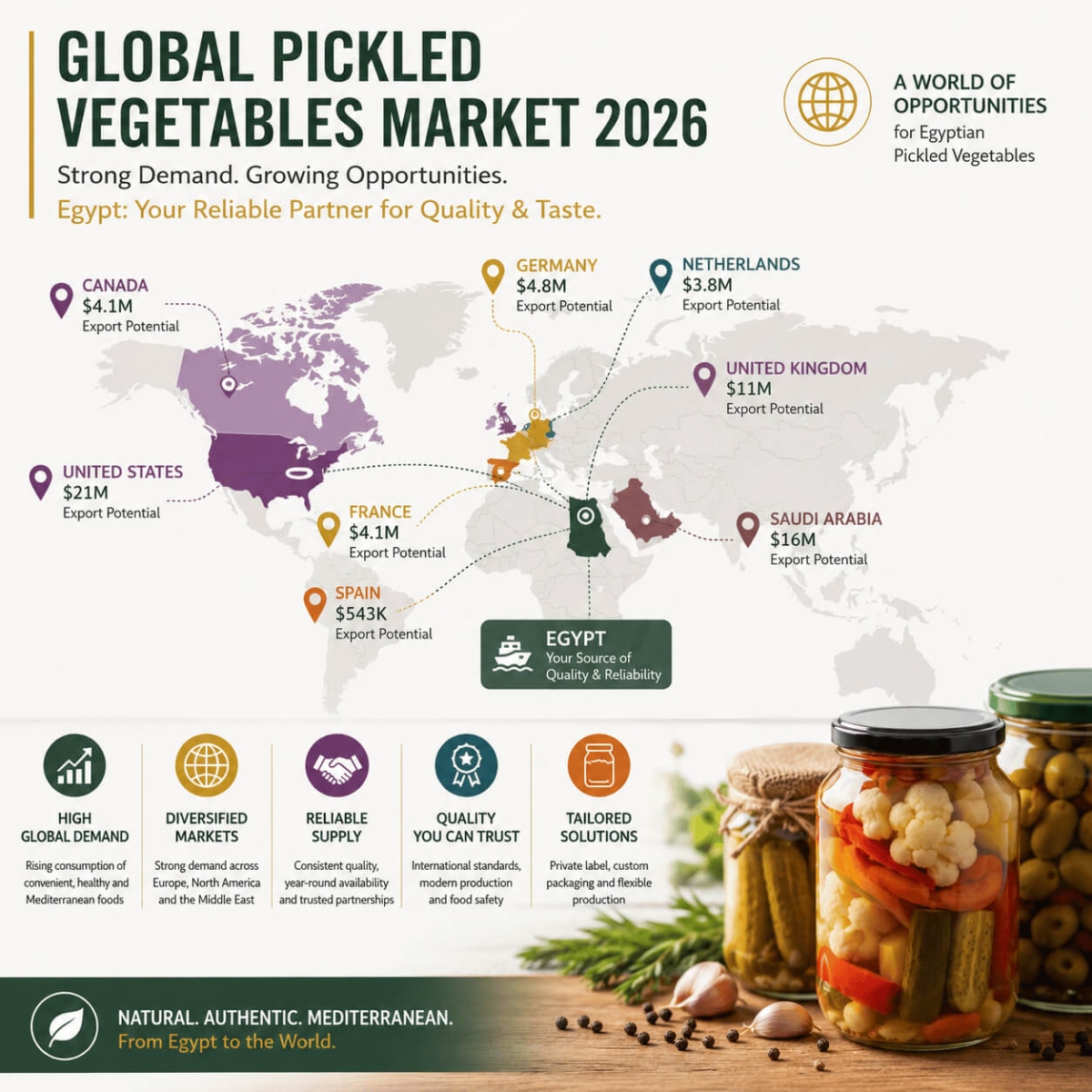
| United States | 21 Million USD |
| Germany | 4.8 Million USD |
| United Kingdom | 11 Million USD |
| Canada | 4.1 Million USD |
| France | 4.1 Million USD |
These markets continue to generate stable demand thanks to mature retail sectors, growing ethnic food consumption, and increasing interest in Mediterranean products.
Export Potential: Where Future Growth Lies
According to the ITC Export Potential Map, several international markets still offer significant untapped opportunities for Egyptian exporters.
| Market | Additional Export Potential |
|---|---|
| Germany | 4.8 Million USD |
| Canada | 4.1 Million USD |
| Netherlands | 3.8 Million USD |
| Spain | 543 Thousand USD |
| Czech Republic | 380 Thousand USD |
These figures represent unrealized export opportunities where Egypt already demonstrates strong competitiveness but has not yet reached its full market potential.
Germany remains one of the most attractive destinations due to its large import volume and diversified supplier base. Canada continues to present opportunities driven by multicultural consumer demand and premium retail channels. Meanwhile, the Netherlands serves as both an import market and a strategic logistics hub for the wider European Union.
Regional Market Insights
Europe
Europe remains Egypt's most important growth region for pickled vegetables. Germany, Spain, Italy, the Netherlands, Poland, Greece, and Romania continue to import increasing volumes from international suppliers to meet demand from supermarkets, foodservice operators, and private-label manufacturers.
European buyers increasingly prioritize:
- Certified food safety standards.
- Consistent year-round supply.
- Flexible packaging solutions.
- Competitive pricing.
- Reliable logistics and long-term supplier relationships.
North America
The United States remains Egypt's largest export destination, accounting for the highest export potential among all international markets. Canada also presents significant room for expansion, supported by growing demand for Mediterranean cuisine and specialty preserved vegetables.
Importers in North America increasingly seek suppliers capable of combining product quality with dependable logistics and scalable production capacity.
Middle East
Although several Middle Eastern markets already import Egyptian pickled vegetables, countries such as the United Arab Emirates continue to offer additional growth opportunities. Strong regional trade links and consumer familiarity with Mediterranean products support further market expansion.
Why Egypt Is Becoming More Competitive
Recent trade data indicates that Egypt is steadily improving its international position through a combination of competitive production costs, favorable agricultural conditions, and increasing compliance with global food safety standards.
Egyptian manufacturers have also expanded their capabilities in:
- Private label manufacturing.
- Customized packaging.
- International certifications.
- Modern processing technologies.
- Flexible production for retail and foodservice sectors.
These strengths enable Egyptian exporters to compete effectively with established suppliers while offering buyers greater sourcing flexibility.
Key Takeaways for International Buyers
- Germany remains the leading growth opportunity within Europe.
- The United States continues to represent Egypt's largest export market.
- Canada and the Netherlands offer substantial untapped export potential.
- Spain and several Central European markets provide attractive medium-term opportunities.
- Buyers increasingly value supplier reliability, certified quality, and long-term partnerships over price alone.
Outlook for 2026
Global demand for pickled vegetables is expected to remain resilient throughout 2026, supported by changing consumer preferences, the expansion of private-label products, and continued diversification of international supply chains.
For importers, distributors, and food manufacturers, selecting suppliers capable of delivering consistent quality, competitive pricing, and dependable year-round supply will remain essential. As Egypt continues to strengthen its export capabilities and expand its international footprint, it is well positioned to become an increasingly strategic sourcing partner for buyers across Europe, North America, and the Middle East.